Local Movers Cost in 2026: What You'll Actually Pay (And the Quote Game)
Local movers cost: From twelve years on the trucks.
Quick answer: A typical three-bedroom local move under 25 miles runs $1,200 to $2,200 in mid-2026, billed by time and crew at $50 to $90 per mover per hour plus travel time and a 2-to-3-hour minimum. Smaller homes cost less (a studio runs $300 to $500, a one-bedroom $400 to $750) and larger homes more. The honest quote is almost always the middle one of three, not the cheapest.
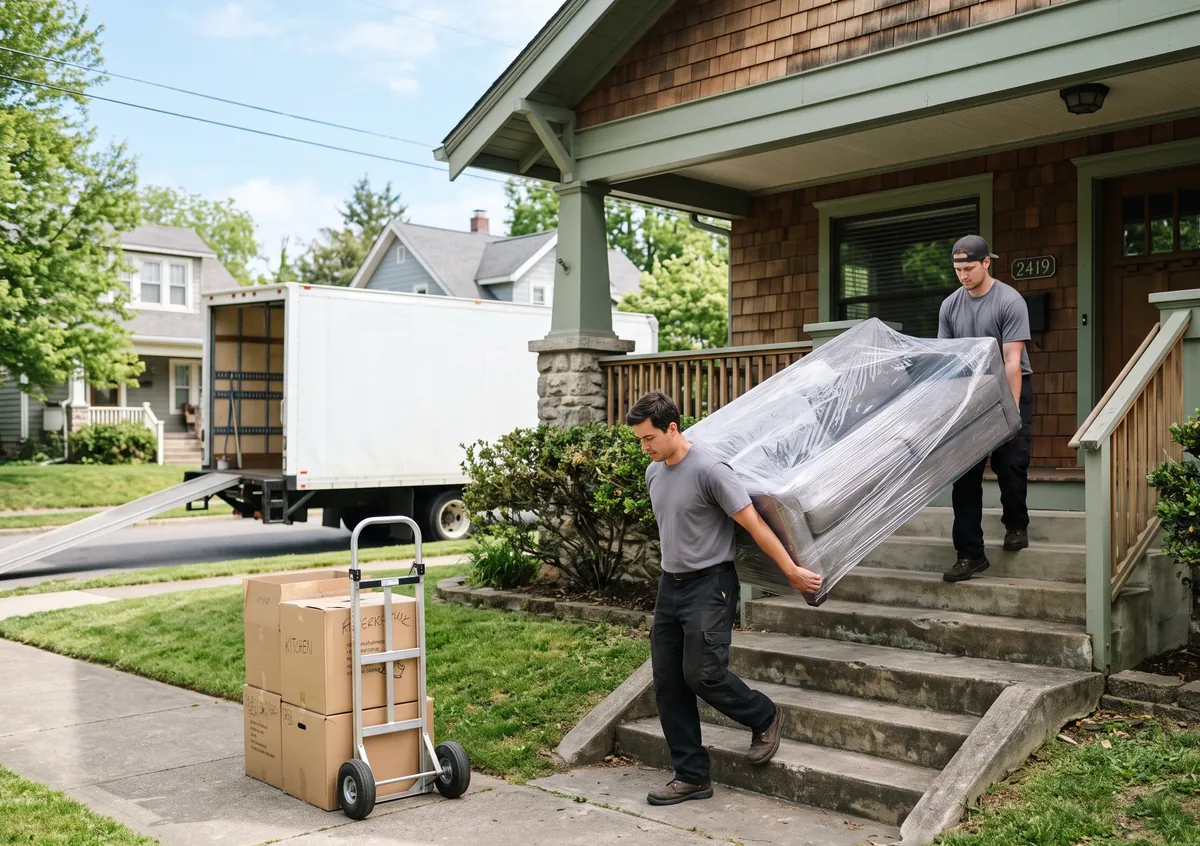
The first quote came in at $620. The second came in at $1,180. The third came in at $1,475. Same address. Same square footage. Same date. Same household. The customer called me confused because she could not figure out why three companies were so far apart, and she was hoping I would tell her the cheapest one was the right one.
The answer was the second one. Here is why, and here is what you actually need to know about local-move pricing in 2026.
I have been in the moving industry for twelve years, the last five running long-haul jobs but with plenty of local moves still on the schedule. The local-move quote is its own game. The pricing structures differ in ways the websites do not explain. The cheapest quote is rarely the company you actually want to hire, and the most expensive is rarely worth the markup. The honest pricing is in the middle, and the test for whether a quote is honest is in how the company handles the math.
Here is the 2026 local-move price grid by home size, all of it under 25 miles, billed at $50 to $90 per mover per hour. Add 10 to 20 percent for 25 to 75 miles, and 20 to 40 percent past 75 miles in the same state.
| Home size | Crew | Typical hours | Cost, under 25 mi (2026) |
|---|---|---|---|
| Studio, ground floor | 2 movers | 2 to 3 hrs | $300 to $500 |
| 1-bedroom apartment | 2 movers | 3 to 4 hrs | $400 to $750 |
| 2-bedroom apt or condo | 2 to 3 movers | 4 to 6 hrs | $700 to $1,200 |
| 3-bedroom house | 3 movers | 6 to 9 hrs | $1,200 to $2,200 |
| 4-bedroom house | 3 to 4 movers | 8 to 12 hrs | $1,800 to $3,500 |
| 5-bedroom or larger | 4+ movers | two-day job | $3,000 to $5,500+ |
Sources: Move.org 2026 moving cost data, moveBuddha 2026 cost dataset, ConsumerAffairs: How Much Do Movers Cost 2026. Hourly rates run higher in NYC, SF, Boston, and LA.
What "local move" actually means
A local move, in the way the moving industry uses the term, is one that stays inside a single state and is typically under 100 miles. Some companies define it as under 50 miles. Most are happy to call it "local" if you are not crossing state lines, even at 90 miles.
The reason this matters: local moves are billed differently than long-distance moves. Long-distance is billed by weight or volume of your goods, with a flat number that includes the drive. Local is billed by time and crew, almost always. Two movers and a truck for X hours, with the rate per hour being the variable.
The pricing structure has three components.
Component one: hourly rate per mover. Typically $50 to $90 per mover per hour in 2026, depending on market. A two-person crew runs $100 to $180 per hour. A three-person crew runs $150 to $270 per hour. A four-person crew runs $200 to $360.
Component two: travel time. The time the truck spends getting to your origin and back from your destination at the end of the day. Some companies charge "double drive time" (twice the actual route time), which is industry standard. Some charge a flat fuel/travel fee. Either is normal. The dishonest version is charging both, or hiding it in fine print.
Component three: minimum hours. Most local movers have a 2-hour or 3-hour minimum. If your move only takes 90 minutes, you still pay for the minimum.
A typical three-bedroom local move at 25 miles takes a three-person crew about 6 to 8 hours. At $200 per hour, plus 90 minutes of double-drive-time at the same rate, plus $30 of fuel surcharge, the honest quote is roughly $1,500 to $1,900 in mid-2026 dollars.
If you are seeing quotes meaningfully below that range, the company is either undersizing the crew (which means more hours) or undersizing the time estimate (which means surprise charges at the end). Neither is your friend.
The hourly-versus-flat-rate trap
A small but growing number of local movers offer "flat rate" pricing for local moves, often pitched as "no surprises, you pay what we quote." This sounds like consumer-friendly framing. It is sometimes a trap.
The flat-rate quote has to assume worst case for the company. If you have stairs, a long carry from truck to door, fragile items, items that do not pre-disassemble, or any of a dozen other complications, the company has built those into the flat rate as a cushion. The flat-rate quote is therefore almost always materially higher than the honest hourly quote for the same move.
The exception is moves that are unusually clean and simple. Studio apartment, ground floor, short carry, no specialty items. For those, flat rate can be competitive.
For typical local moves (multi-bedroom, some stairs, mixed item sizes), an honest hourly quote from a reputable company will beat a flat rate quote from the same company.
The question to ask: "What is your hourly rate, what is your minimum, what is your travel-time policy, and what is your typical time estimate for a household my size?" If the company will not give you all four numbers, walk.
→ Pull three quotes from local movers in your zip code before you commit to one. Compare the four numbers above side by side. The dishonest quotes show themselves on the first comparison.
Pricing by household size, 2026 reality
These are honest mid-2026 ranges for local moves under 25 miles. Add 10-20% for moves in the 25-75 mile range, 20-40% for moves over 75 miles within the same state.
Studio apartment, ground floor, simple: $300 to $500. 2-3 hours, two-person crew. Most efficient move in the catalog.
One-bedroom apartment: $400 to $750. 3-4 hours, two-person crew. The variability is mostly stairs.
Two-bedroom apartment or small condo: $700 to $1,200. 4-6 hours, two- or three-person crew.
Three-bedroom house: $1,200 to $2,200. 6-9 hours, three-person crew. Wide range driven by stairs, garage, basement, and how much pre-packing you have done.
Four-bedroom house: $1,800 to $3,500. 8-12 hours, three- or four-person crew. Often runs into a second day.
Five-bedroom or larger: $3,000 to $5,500+. Usually two-day jobs. Specialty handling for pianos, gun safes, art collections adds line items.
The variance within each range is mostly driven by:
- Stairs (each flight adds 30-60 minutes)
- Distance from truck to door
- Specialty items (pianos, safes, oversized art)
- How much packing you have done versus how much they need to do
- Weather (rain or snow extends loading times by 25-50%)
Surge windows that change the math
Local move pricing is not constant. Three windows where prices materially climb.
Last weekend of the month, May through August. This is when most leases turn over. Demand is at peak. Prices climb 15-30%. Availability drops. If you can move on the second Tuesday of the month instead of the last Saturday, you will save real money.
Friday afternoons in any season. People want to move Friday after work for a Saturday-Sunday unpack. Prices climb 10-15%. Tuesday and Wednesday are the cheapest days of any given week.
Holiday weekends. Memorial Day, Labor Day, Fourth of July, even some of the smaller holidays. Surge pricing applies to the entire long weekend. The Tuesday after a holiday is sometimes deeply discounted because the moving companies have empty trucks they want to fill.
If your timing is flexible, ask the moving company what their off-peak windows are. They will sometimes offer a 10-15% discount for moves scheduled during slow periods. They will sometimes throw in extra packing materials. They will rarely turn down a flexible customer.
What the cheap quote is hiding
The customer who got the $620 quote at the top of this article was getting a real quote from a real company that operated as follows: undersize the crew (two movers for a three-bedroom that needed three), under-estimate the time (4 hours for a job that takes 7), and bill the actual hours at the end. The honest cost when the day was done was $1,400, but it landed as a "surprise" rather than a quoted price.
This is the most common dishonest-quoting pattern in the local-move industry. The company knows what the actual cost will be. They quote the cost of the first 4 hours specifically, not the cost of the entire job. The customer reads the bottom line and books based on it. The bill at the end is something else.
The defense: ask the company directly, "What is your time estimate for a household my size?" Their answer will be honest, because lying about the time estimate puts them in a position where they have to defend a bad quote on the day of the move. If they say "5-7 hours" and you got a quote based on 4, you know the quote was bait.
What the expensive quote is asking for
The $1,475 quote was a national-brand mover with high overhead, brand premium, and conservative time estimates. It was not dishonest. It was just expensive. Their argument is that they have insurance, they vet their crews, they hold their drivers to higher standards, and the price reflects that. All of which is true.
For high-value households (lots of fragile items, art, antiques) or for customers whose time is meaningfully more valuable than the cost delta, the premium tier is worth it. For everyone else, the middle-priced honest mid-tier company is the better answer.
How to actually compare quotes
Three rules.
Rule one: get at least three quotes, and do not tell each company what the others quoted. The companies will price-match each other if they think you are shopping, but the price-match is often based on undersizing the crew. The honest quotes come when each company is bidding the job they will actually do, not the job that beats the lowest competitor.
Rule two: compare the four numbers, not the bottom line. Hourly rate, minimum hours, travel-time policy, time estimate for your household. If those four numbers line up reasonably across all three quotes, the bottom-line differences are real. If one company is materially different on any one of the four, that is where the dishonesty is hiding.
Rule three: read the contract before you commit. The contract specifies what happens if the move runs over the estimate, what happens if items are damaged, what the refund policy is for cancellation. The honest companies have clean contracts. The dishonest ones have language designed to enable the surprise charges.
→ Get three local-mover quotes through one form for your zip code. Compare on the four numbers above. The honest answers separate from the bait quotes within five minutes.
What to budget if you do not want surprises
If you are a typical three-bedroom household moving 15-25 miles, the realistic mid-2026 budget is $1,500 to $2,000 for the move itself, plus 10-15 percent tip ($150-$300), plus packing supplies if you are providing your own ($100-$200). Total cost in pocket: $1,750 to $2,500.
If your move is bigger, smaller, or unusual, scale the budget proportionally. The ratios above hold reasonably well across the full range of household sizes.
The goal is not the cheapest move. The goal is the move that actually goes well, with a company that quoted honestly and showed up with the right crew. The price difference between the cheapest dishonest quote and the cheapest honest quote is usually real money. The price difference between the cheapest honest quote and the most expensive honest quote is often not worth the difference for typical scenarios.
Pick honest. Pick the middle. Tip the crew well if they did the job right.
→ Start your three-quote comparison here. Local movers in your zip code, real quotes, no obligation.
Frequently Asked Questions
How much does a local move cost in 2026?
For moves under 25 miles, expect $300 to $500 for a studio, $400 to $750 for a one-bedroom, $700 to $1,200 for a two-bedroom, $1,200 to $2,200 for a three-bedroom house, and $1,800 to $3,500 for a four-bedroom. Add 10 to 20 percent for moves in the 25-to-75-mile range and 20 to 40 percent beyond 75 miles within the same state.
Why are local moving quotes so different from each other?
Local moves are billed by time and crew, so the bottom-line number depends on how the company estimates hours, crew size, and travel time. A lowball quote usually undersizes the crew or under-estimates the time and bills the real hours at the end as a surprise. Compare the hourly rate, the minimum hours, the travel-time policy, and the time estimate for your household size rather than the bottom line.
Is flat-rate or hourly pricing cheaper for a local move?
For a typical multi-bedroom move with some stairs and mixed item sizes, an honest hourly quote usually beats a flat-rate quote from the same company, because the flat rate has to assume worst case and pad in a cushion. Flat rate can be competitive only for unusually clean and simple moves, like a ground-floor studio with a short carry and no specialty items.
What is the cheapest time to book local movers?
Avoid the last weekend of the month from May through August, when leases turn over and prices climb 15 to 30 percent, and avoid Friday afternoons and holiday weekends. Tuesday and Wednesday are the cheapest days of any week, and the Tuesday after a holiday is sometimes deeply discounted because companies have empty trucks to fill.
How much should I budget for a three-bedroom local move?
For a three-bedroom household moving 15 to 25 miles, budget $1,500 to $2,000 for the move itself, plus a 10 to 15 percent tip ($150 to $300), plus $100 to $200 for packing supplies if you provide your own. That puts the realistic total in pocket at roughly $1,750 to $2,500.
Before you book, it is worth confirming the company is legitimate. The FTC's guide to hiring a moving company covers the consumer-protection basics, and the FMCSA's Protect Your Move database lets you check a mover's record.
Have a local-move quote story or a price you want me to sanity-check? Send it to stories@moving-crews.com. The patterns repeat across markets.